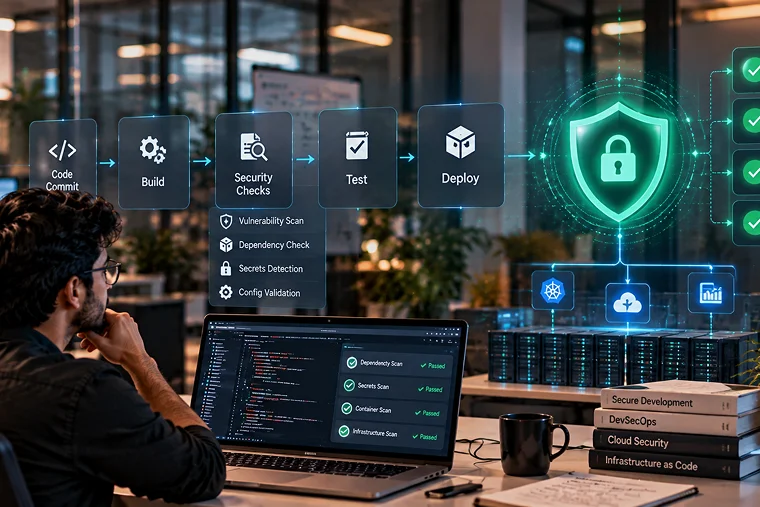






DevOps Services & Solutions

Your software delivery process should not slow down product growth. We help engineering teams automate CI/CD, modernize cloud infrastructure, strengthen security, improve reliability, and build platforms that can scale with changing business needs.

  • Certified DevOps Engineers
  • Cloud & Platform Expertise
  • Enterprise DevOps Projects
  • Global Delivery Experience
Discuss Your DevOps Challenge

Our Reputed Clients

Core DevOps Services Our Experts Offer

Rather than overwhelming your team with a long list of individual capabilities, our core DevOps services focus on six areas that directly affect software delivery and operations.

  • DevOps automation services works best when it starts with a thorough understanding of existing workflows. We evaluate processes to identify bottlenecks and then create tailored automation solutions that address these constraints, enhancing overall efficiency and delivery speed. DevOps assessment and roadmap

    • DevOps assessment and roadmap
    • Workflow automation
    • Infrastructure automation
    • Configuration management
  • Our Cloud & DevOps consulting services assist with cloud migration planning, environment modernization, and resource optimization across AWS, Azure, and Google Cloud, using tools like Terraform and Ansible for consistent infrastructure management.

    • Cloud migration and modernization
    • AWS, Azure, and Google Cloud
    • Infrastructure as Code
    • Cloud cost optimization
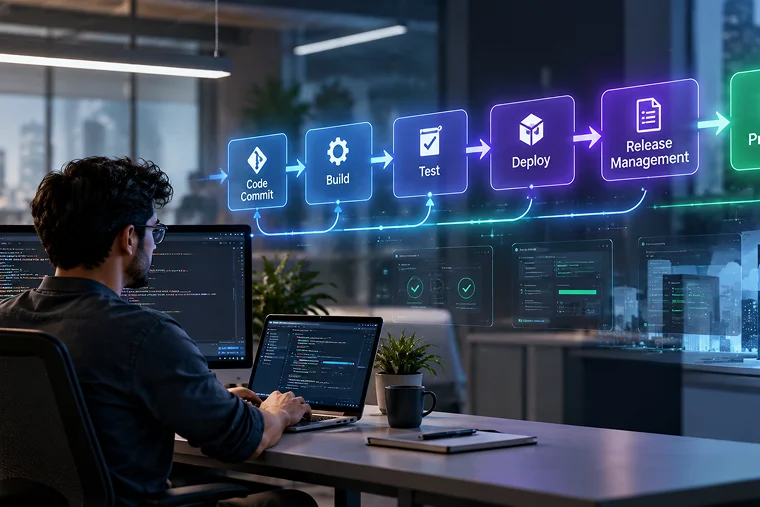
  • Manual processes in builds, testing, approvals, and deployments can hinder speed and consistency. We design CI/CD pipelines to automate these stages, ensuring a smooth transition from code commit to production with tools like Jenkins and GitHub Actions.

    • CI/CD pipeline design
    • Automated testing workflows
    • Continuous delivery
    • Release orchestration
  • We implement DevSecOps to prevent security vulnerabilities from delaying our releases. By incorporating security checks throughout development, build, testing, and deployment, we ensure issue identification and foster consistent security practices within our team.

    • Secure CI/CD pipelines
    • SAST and DAST integration
    • Security monitoring
    • Vulnerability management
  • Kubernetes helps organizations manage containerized applications at scale, but does not reduce complexity on its own. We assist teams with platform design, automation, GitOps practices, and self-service capabilities to streamline workflows and improve efficiency.

    • Kubernetes implementation
    • Docker and containerization
    • Cluster management
    • Internal developer platforms
  • Enhancing reliability requires more than just dashboards. Site Reliability Engineering (SRE) integrates engineering, automation, and observability to improve production system consistency, while increasing visibility and accelerating problem resolution through use of metrics, logs, and traces.

    • SRE implementation
    • Logs, metrics, and traces
    • Alerting and anomaly detection
    • SLO/SLI implementation
Consultants reviewing a DevOps delivery assessment with an engineering lead Cloud infrastructure blades running in a data centre rack Engineer working through build and release pipelines at a dual-monitor workstation Structured fibre patch panel carrying controlled traffic between systems Platform engineers pairing on a containerised workload Operations engineer watching live service metrics across a monitoring wall

Success Stories Showcasing Our DevOps Excellence

Global network of connected cities seen from orbit

Cloud-Native Transformation with DevOps Automation

Reliance Jio needed to modernize its infrastructure and move from on-premises systems and monolithic architecture toward cloud-native microservices. Manual provisioning, releases, and code checks were slowing development and limiting scalability. The DevOps transformation introduced Kubernetes-based infrastructure automation, CI/CD pipelines, automated provisioning, multi-platform release workflows, and integrated quality gates.

Logistics warehouse with racked shipments ready for dispatch

Cloud & DevOps Transformation for Scalable Logistics

Ecom Express needed to handle growing shipment volumes, real-time tracking requirements, and traffic spikes without allowing infrastructure bottlenecks to slow operations. Fragmented data pipelines and manual deployment processes also made scaling difficult. The transformation introduced auto-scaling cloud infrastructure, microservices, CI/CD pipelines, real-time monitoring, and zero-downtime deployment practices.

Engineer monitoring an automated production line

Integrated Managed DevOps & Cloud Transformation

A leading two-wheeler manufacturer was dealing with rising cloud costs, performance bottlenecks, limited automation, and gaps in monitoring. The business needed a more structured DevOps framework that could improve reliability without adding operational complexity. The transformation combined cloud cost optimization, CI/CD automation, containerization, security hardening, disaster recovery, infrastructure automation, and continuous monitoring.

Not Sure Where Your DevOps Bottleneck Is?

We can help identify where automation or reliability engineering can make the biggest difference.

Discuss Your DevOps Challenge

What Can DevOps Improve in Your Software Delivery?

The right DevOps approach depends on where your current process is slowing down. Along with CI/CD automation, we prioritize cloud modernization, Kubernetes, and DevSecOps.

Deliver Software Faster Without Manual Work

We look at the journey from code commit to production and identify where time is being lost. From there, we automate repeatable steps across building, testing, deployment, and release management.

Source code on a developer's monitor during a release build

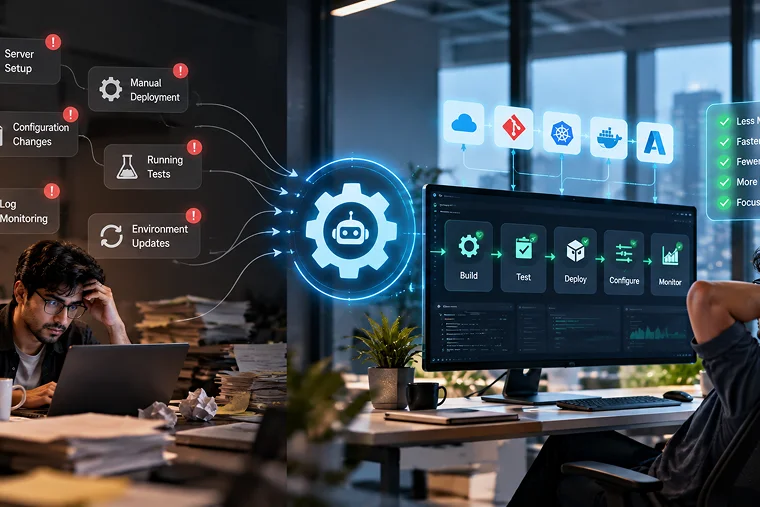
Automate the Work Your Team Does Not Repeat

Our DevOps development services identify these repetitive tasks across infrastructure, deployments, configuration, testing, and operations and automate them where automation can genuinely reduce effort or risk.

Illuminated circuit traces representing automated systems

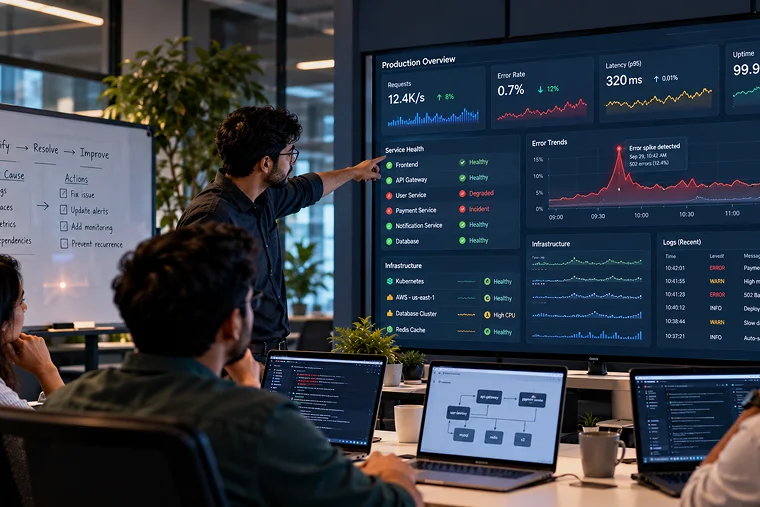
Make Production Problems Easier to Find

Our observability and SRE work helps teams understand where failures are happening, how applications are behaving under load, and which issues need immediate attention.

Observability dashboard showing live system metrics

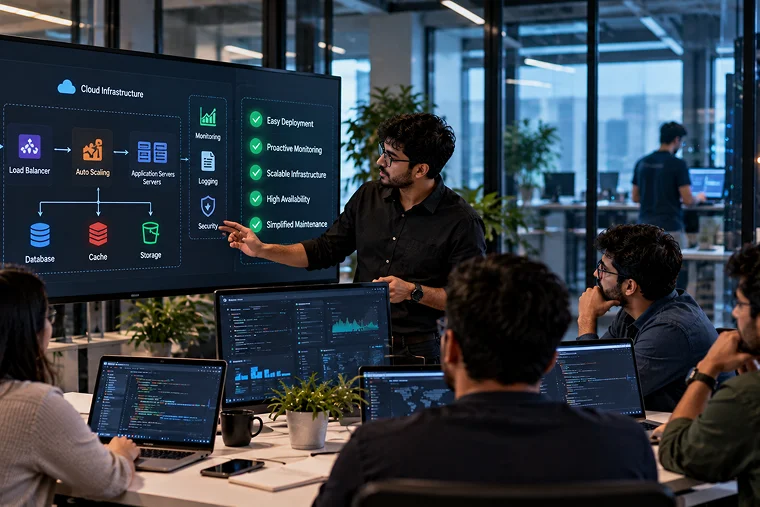
Build Infrastructure That Can Keep Up With Your Application

As your strategic DevOps partner, we focus on infrastructure that is easier to deploy, monitor, maintain, and scale rather than being complicated simply for the sake of being modern.

Data centre racks with structured network cabling

Build Security Into the Delivery Process

Our DevSecOps consulting services security checks into development and deployment workflows so vulnerabilities, insecure dependencies, exposed secrets, and configuration issues can be identified earlier.

Padlock resting on a keyboard representing pipeline security

AI-Driven DevOps: Where Automation Becomes More Intelligent

We use AI-assisted capabilities where they can reduce operational effort, improve visibility, or help engineering teams make faster decisions rather than simply adding an “AI” label to existing tools.

What Should You Expect from a DevOps Partner?

A DevOps partnership should result in measurable improvements to how software is built, deployed, and operated.

Two engineers reviewing delivery workflows together at a laptop
  • Make Delivery More Repeatable

    We implement CI/CD pipelines, automate testing, adopt infrastructure as code, and establish standardized deployment workflows to minimize variations and reduce manual efforts in our software releases.

  • Build Infrastructure That Can Adapt

    We design cloud and container infrastructure to align with workload requirements, enabling our teams to efficiently provision, scale, and manage environments consistently across various applications.

  • Know What Is Happening in Production

    We utilize observability tools to integrate metrics, logs, traces, alerts, and system events, allowing our engineering teams to gain insights into application performance and infrastructure behavior in real time.

  • Reduce Operational Dependency on Manual Work

    We automate repetitive tasks such as provisioning, deployment, testing, and configuration, empowering our engineers to focus on more strategic, high-value projects that drive innovation and efficiency.

The Tools Behind Our DevOps Expertise

Hire DevOps engineers to work across CI/CD, cloud infrastructure, containers, Infrastructure as Code, observability, security, networking, and configuration management.

Jenkins
GitHub Actions
GitLab CI/CD
CircleCI
Argo CD
Tekton
Docker
Kubernetes
Helm
OpenShift
Terraform
Ansible
CloudFormation
Pulumi
AWS
Microsoft Azure
Google Cloud
Prometheus
Grafana
ELK
OpenTelemetry
Datadog
Dynatrace
SonarQube
Snyk
Trivy
Vault
OWASP tooling

How Can You Work With Our DevOps Engineers?

Different DevOps requirements call for different levels of involvement. You can work with a dedicated engineering team for ongoing requirements, use a project-based model for a defined initiative, or start with consulting when the technical direction still needs to be established.

01

Dedicated DevOps Team

Best suited for
Ongoing infrastructure and DevOps requirements
How it works
Engineers work continuously with your existing team
02

Project-Based

Best suited for
Defined DevOps implementation
How it works
Scope, milestones, and delivery are agreed upfront
03

Consulting & Advisory

Best suited for
Assessment, architecture, or roadmap
How it works
DevOps specialists provide technical direction and recommendations

Build the DevOps Environment Your Engineering Team Actually Needs

We’ll help you define the technical priority, choose the appropriate approach, and determine what should be implemented first.

Discuss Your DevOps Roadmap

Where DevOps Has the Greatest Operational Impact

Different industries have different reliability, security, compliance, scalability, and release requirements.

What Clients Say About Working With Us

Frequently Asked Questions

DevOps services typically include software delivery automation, CI/CD implementation, cloud infrastructure engineering, Infrastructure as Code, security integration, container orchestration, observability, reliability engineering, and ongoing optimization. The exact scope depends on the organization’s delivery and infrastructure challenges.

DevOps improves software delivery by automating repetitive processes such as building, testing, provisioning, and deployment. It also establishes more consistent workflows between development, infrastructure, security, and operations teams, which can reduce manual bottlenecks and release risk.

A company should consider DevOps support when releases are slow, deployments are heavily manual, infrastructure is difficult to manage, production incidents are frequent, cloud costs are increasing, or developers are spending significant time on operational tasks.

DevOps can reduce deployment failures by standardizing release processes, automating testing and deployment steps, introducing infrastructure as code, adding security checks, and establishing monitoring and rollback mechanisms.

Yes. Cloud cost optimization can involve resource right-sizing, utilization analysis, automated scaling, infrastructure changes, workload optimization, and identifying unused or over-provisioned resources. The exact savings depend on the existing architecture and usage patterns.

DevOps is a broader approach to improving collaboration, automation, software delivery, and operations. SRE applies software engineering practices specifically to reliability, availability, performance, and operational risk.

Kubernetes is useful when an organization needs consistent orchestration, deployment, scaling, and management of containerized workloads. It is not automatically the right solution for every application. The workload, team expertise, operational complexity, and scaling requirements should determine whether Kubernetes is justified.

DevSecOps integrates security into development and delivery workflows. It helps teams identify vulnerabilities earlier by incorporating security testing, dependency checks, secrets management, container scanning, and other controls throughout the software lifecycle.

Yes. DevOps modernization does not always require replacing an existing toolchain. The appropriate approach depends on what is currently working, where the bottlenecks exist, and whether the existing tools can support the required workflow.

There is no fixed timeline because DevOps projects vary considerably. A focused CI/CD improvement can take substantially less time than a cloud migration, Kubernetes implementation, platform engineering initiative, or organization-wide DevOps transformation.