Your Infrastructure Has a Problem. The Right DevOps Engineer Can Own It.
Slow deployments. Manual provisioning. Kubernetes failures. Escalating cloud costs. Each problem requires a specific DevOps capability. Each capability needs the right engineer. We match you to the engineer who can own and solve your exact problem. You get results. Not a generic hire.
- Zero replacement cost if the fit is wrong
- 85% resource retention across active engagements
- On your tools, in your timezone, from day one
- Matched to your stack, not a generic shortlist
Where Is Your Engineering Delivery Failing?
Most engineering problems have a pattern. Recognize yours below. Each problem maps directly to a specific DevOps capability.
-
Releases Take Too Long and Break Too Often
Your team deploys weekly or monthly. Every release is a manual, high-risk event. Failed deployments mean hours of rollback and lost developer confidence. The pipeline is the problem. It needs to be rebuilt, not tweaked.
-
Cloud Infrastructure Is Manual and Expensive
Your environment is configured by hand. No two environments match exactly. Your cloud bill is growing. Nobody can clearly explain why. Manual infrastructure is fragile. One wrong change triggers a production incident.
-
Production Incidents Are Escalating
You find out about production problems when customers report them. Incident response is reactive, manual, and exhausting for your team. The mean time to recover is measured in hours, not minutes.
-
Kubernetes Is Unstable or Unmanaged
Workloads are containerized. Your cluster stability is another matter. Scaling events cause outages. Cluster configuration is not documented. Nobody on the team has full ownership of the Kubernetes environment.
-
Security Is Bolted On at the End
Security review happens after the code is written. Sometimes it is deployed. Containers are not scanned. Secrets live in environment files. Your pipeline has no embedded security controls at any stage.
-
Developers Spend Too Much Time Waiting
Developers wait days for a new environment to be provisioned. Access requests, environment setup, and tooling are all manual. Every hour spent waiting is an hour not spent building a product.
Not Sure Which Problem Maps to Which Capability?
Talk to One of Our DevOps ArchitectsSix DevOps Capabilities. Each One Solves a Specific Delivery Problem.
You have identified the problem. Now see what the relevant capability covers. Each capability below maps to what the engineer owns and what outcome to expect.
CI/CD and Release Engineering
Customer Problem
Your team deploys weekly or monthly. Every release is a manual event. A single failed deployment means hours of rollback. Developers have lost confidence in the release process.
What the Engineer Owns
End-to-end pipeline design and maintenance. Automated testing integration. Deployment strategy selection across blue/green, canary, and feature flags. Rollback automation. Release gate configuration.
Technical Capability
GitHub Actions
GitLab CI
Jenkins
ArgoCD
Flux
Tekton
CircleCI
- Automated test frameworks
- Pipeline performance tuning
- Deployment observability
Business Outcome
Multiple daily deployments become safe and routine. Change failure rate drops below industry median. Time from code to commit to production shrinks from day to hour.
When to Hire This Capability
- Your team deploys manually.
- Deployments take more than one day.
- Post-deployment incidents are frequent.
- Developers perform operations work to release code.
Cloud Infrastructure and Migration Engineering
Customer Problem
Your infrastructure was built incrementally. Environments are inconsistently configured. A cloud migration has stalled or is significantly over budget. Cloud bills are growing, and nobody can explain the cause.
What the Engineer Owns
Cloud architecture design and review. Environment standardization. Migration planning and phased execution. Cost modelling. Post-migration optimization and ongoing environment management.
Technical Capability
 AWS
 Azure
GCP
- Multi-cloud
- VPC architecture
- IAM design
- Auto-scaling and high-availability design
- Cloud readiness assessment
- Lift-and-shift execution
- Re-platforming and data migration
Business Outcome
Predictable, documented, fully version-controlled infrastructure. Cloud migration completed with a clear cost model and defined timeline. Shadow infrastructure is eliminated. Production environments have become reliable.
When to Hire This Capability
- You are planning or mid-way through a cloud migration.
- Cloud bills are unclear or growing month over month.
- Your team cannot explain the current cloud architecture to leadership.
Infrastructure as Code and Automation Engineering
Customer Problem
Your infrastructure is configured by hand. It is documented in one person's head. One departure from a serious incident. New environment setup takes days and is never identical to the last.
What the Engineer Owns
Full IaC codebase design and maintenance. Terraform module architecture. Environment drift prevention. CI/CD integration for all infrastructure changes. Configuration management across all environments.
Technical Capability
Terraform
OpenTofu
Ansible
Pulumi
- CloudFormation
- CrCrossplane
Chef
Puppet
- IaC testing frameworks
- Environment drift detection tools
Business Outcome
Every environment is reproducible, version-controlled, and auditable. Infrastructure provisioning time drops from days to under an hour. Environment differences causing deployment failures are permanently eliminated.
When to Hire This Capability
- Your infrastructure is not written as code.
- Environment inconsistencies cause deployment failures.
- New environment setup takes more than one day.
- Infrastructure knowledge depends on a single person.
Kubernetes and Container Platform Engineering
Customer Problem
Your applications are containerized. Your Kubernetes cluster is another matter. Cluster instability is traced back to configuration decisions nobody owns. Scaling events trigger outages. Multi-cluster management is beyond current capacity.
What the Engineer Owns
Cluster architecture and ongoing maintenance. Workload scheduling. Horizontal and vertical pod autoscaling. Network policies. Persistent storage management. Multi-cluster strategy. Helm chart ownership.
Technical Capability
- EKS
- AKS
Kubernetes stable release
Helm
- KuKustomize
Istio or Linkerd service mesh
- KKEDA
Cilium and eBPF
OpenShift
Rancher
Business Outcome
A stable, production-grade Kubernetes platform. Workloads scale automatically and safely during peak traffic. Deployment failures traced to cluster configuration are eliminated. Engineering teams deploy without operations intervention.
When to Hire This Capability
- Your cluster is managed by someone who also does other work.
- You are migrating to Kubernetes and need an architect.
- Production Kubernetes incidents are recurring.
- Nobody can explain the current cluster state.
DevSecOps and Software Supply Chain Security
Customer Problem
Security is reviewed at the end of delivery. Sometimes after deployment. Vulnerabilities are found in production. Container images are not scanned. Secrets are stored in environment files. Compliance audits expose pipeline gaps.
What the Engineer Owns
Security policy definition and enforcement across the pipeline. SAST and DAST integration into CI/CD. Container image scanning. Secrets management. Software composition analysis. Compliance-as-code.
Technical Capability
Snyk
Trivy
Aqua Security
- CkCheckov
- OPAOpen Policy Agent
Falco
SonarQube
HashiCorp Vault
- AWS Secrets Manager
- Azure Key Vault
- SBOM generation
Business Outcome
Security embedded at every pipeline stage. Vulnerabilities caught before reaching production. Compliance evidence generated automatically by the pipeline. Risk surface is continuously visible and managed.
When to Hire This Capability
- You are preparing for a SOC 2, ISO 27001, HIPAA, or PCI-DSS audit.
- Your containers run without image scanning.
- Secrets are managed informally.
- Security review slows your delivery.
SRE, Observability, and Reliability Engineering
Customer Problem
You find out about production problems when customers report them. Incident response is manual, reactive, and burning out your team. You have monitoring dashboards. They do not answer why something broke.
What the Engineer Owns
SLO and SLI definition. Full-stack observability stack design and maintenance. Alert rule design. Incident response process. Runbook creation. On-call rotation management. Post-incident review process.
Technical Capability
Prometheus
Grafana
OpenTelemetry
- LLoki
Jaeger
Datadog
New Relic
Dynatrace
PagerDuty
ELK Stack
- Distributed tracing
- Synthetic monitoring
- SLO-based alert
Business Outcome
Defined SLOs with real-time visibility tracked against them. Mean time to recovery was measured and consistently improving. Production incidents detected before customer impact. On-call rotation designed for sustainability, not engineer burnout.
When to Hire This Capability
- Customers report production problems before your team detects them.
- MTTR is measured in hours or days, not minutes.
- Engineers are burning out on on-call rotation.
- Monitoring shows something is broken but not why.
What DevOps Engineers Should Own in Your Organization
Most hiring decisions fail because ownership is not defined before the engineer starts. Here are the five ownership domains your DevOps engineer should be accountable for. Not every engagement requires all five. Define the critical gap first.
-
01
Full Pipeline Ownership
The engineer owns CI/CD design, deployment strategy, and release quality end to end. Every deployment is reproducible. Every failure has a clear rollback path. This ownership means no deployment goes to production without passing defined gates.
-
02
Infrastructure Ownership
The engineer owns all infrastructure such as code, cloud environments, and provisioning. Every environment is version-controlled and auditable. None require manual intervention. Provisioning a new environment takes minutes, not days.
-
03
Platform Ownership
The engineer owns developer tooling, internal platforms, and environment access. Developers in self-serve environments, deployments, and common infrastructure tasks. Developer waiting time for infrastructure is measured and actively reduced.
-
04
Reliability Ownership
The engineer owns SLOs, incident response, and production of health metrics. A missed SLO triggers a structured review, not a blame cycle. Production is monitored proactively. Incidents are rare and short.
-
05
Security Ownership
The engineer owns policy enforcement, scanning, and compliance tooling. No code reaches production without passing defined security checks. Security evidence is generated automatically and stored for audit.
Choose the Engagement Model That Fits Your Situation
Once you have identified the capability and ownership scope, the model follows. Choose based on how urgent the need is and how long the work will last.
| Engagement Model | When to Choose This | Best For | Not Right For |
|---|---|---|---|
Hourly DevOps Engagement |
You have a specific, bounded task. The scope is defined and time-limited. Examples: a pipeline audit, a Kubernetes cluster review, a CI/CD implementation, and a security assessment. | Audits, setup tasks, spike work, one-off migrations, and infrastructure reviews. | Ongoing ownership of production infrastructure or on-call responsibilities. |
Project-Based DevOps Engagement |
You have a defined delivery objective with a clear outcome and end date. Examples: cloud migration, new CI/CD platform build, DevSecOps pipeline implementation. | Migrations, platform builds, compliance implementations. | Production operations, ongoing incident response, or continuous delivery ownership. |
Dedicated DevOps Engineer |
You need a DevOps engineer embedded in your team for an extended period. This engineer participates in standups, owns specific infrastructure domains, and is accountable for delivery outcomes. | Growing engineering teams needing ongoing DevOps coverage. SaaS companies are building platforms. Startups are not yet ready for a full in-house hire. | Short-term or one-off tasks where a bounded engagement is more efficient. |
Dedicated DevOps Team |
Your platform has multiple simultaneous capability gaps. One engineer cannot cover CI/CD, Kubernetes, security, and observability together. You need a coordinated team with divided ownership across capability areas. | Scale-ups with complex infrastructure. Enterprise platform migrations. Companies building an SRE function from zero. | Companies that only need one specific problem solved. |
For fully managed DevOps (operational outsourcing rather than team augmentation), see our dedicated Managed DevOps service.
How We Match, Evaluate, and Onboard DevOps Engineers
No long recruitment cycles. No generic CVs. No guesswork. Five steps from problem identification to contributing engineer.
-
Step 1
Problem Mapping
We begin by mapping your specific engineering problem. Not your job description. We ask about the current deployment frequency. Incident history. Infrastructure complexity. Team size. Cloud environment. Existing tooling. From this, we identify the right capability profile and seniority level. This step determines everything that follows.
-
Step 2
Candidate Identification
We match against our vetted engineer pool using your capability profile. We do not send generic DevOps CVs. We send targeted profiles. Each shortlisted engineer has verifiable experience in your specific problem area. Not tool familiarity. Actual production experience.
-
Step 3
Technical Evaluation
You interview the shortlisted engineers. We provide a technical evaluation framework. The framework covers your specific capability areas. Not generic DevOps questions. You choose who you work with. We do not make that decision for you.
-
Step 4
Onboarding and Integration
The engineer joins your communication channels and existing standups. They complete an infrastructure and codebase review in the first two weeks. We stay involved during onboarding to ensure integration is working smoothly.
-
Step 5
Ongoing Assurance
Monthly check-ins throughout the engagement. Zero replacement cost if fit is wrong. We act immediately, without negotiation. We remain available throughout the engagement, not just at the point of placement.
The Technology Stack Our Developers Work With
The right engineer has hands-on production experience with your actual tools. Not certifications that pre-date the technology your environment runs today.
- AWS
- Microsoft Azure
DigitalOcean
 Oracle Cloud
- CloudFormation
- CrCrossplane
Bamboo
Docker
- KuKustomize
- KKEDA
Linkerd
- eeBPF
- LLoki
Splunk
- CoCoralogix
- CkCheckov
- OPAOpen Policy Agent
- AWS Secrets Manager
- Azure Key Vault
Backstage
- PPort
- HHumanitec
Infracost
- CHCloudHealth
- SSpot.io
- KcKubecost
- MMoogsoft
- BPBigPanda
- HHarness
- CoCoralogix
Git
GitHub
Bitbucket
Python
Bash
Go
YAML
HCL
Engineer Certifications

This stack reflects production usage in 2026 environments. We do not add technologies for keyword coverage. If your environment uses a tool not listed here, tell us. We likely already support it.
DevOps Looks Different Depending on What You Build
DevOps requirements are not the same across industries. Compliance demands, traffic patterns, and release constraints differ materially.
-
SaaS and Technology Companies
Industry Problem
Multi-tenant architecture demands zero-downtime deployments. Release velocity is a direct competitive differentiator. Infrastructure must scale automatically during traffic surges.
DevOps Requirement
CI/CD at scale. Feature flag infrastructure. Kubernetes multi-tenancy. SLO-based reliability engineering.
-

FinTech and Banking
Industry Problem
Regulated environments require full audit trails for infrastructure changes. Security is non-negotiable at every stage. Deployment windows are narrow and change approval is mandatory.
DevOps Requirement
Compliance-as-code. DevSecOps-embedded pipelines. Change management automation. SOC 2 and PCI-DSS tooling integration.
-

Healthcare and Life Sciences
Industry Problem
HIPAA and GDPR compliance must be maintained across all environments. Data security and access control are subject to external audit. Any infrastructure change must be traceable.
DevOps Requirement
HIPAA-compliant cloud architecture. Secrets management. Data isolation controls. Audit log automation. IaC designed to generate compliance evidence automatically.
-

eCommerce and Retail
Industry Problem
Traffic is unpredictable. Peak events like Black Friday demand instant scale. Infrastructure must expand in minutes and contract after peak. Downtime during high-traffic periods is directly translated to lost revenue.
DevOps Requirement
Auto-scaling infrastructure. Kubernetes KEDA-based horizontal scaling. Load testing integrated into CI/CD. CDN and edge infrastructure management.
-
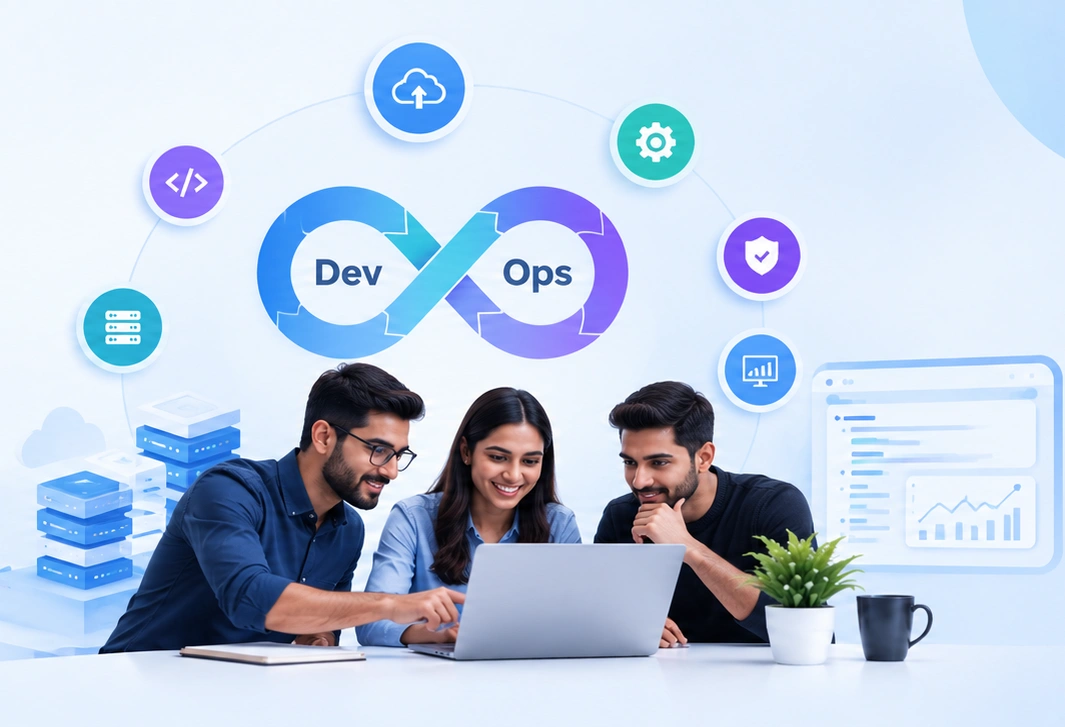
Startups and Scale-Ups
Industry Problem
Engineering team is small. No dedicated DevOps function exists. Developers are doing infrastructure work alongside product development. This slows product delivery and increases technical debt.
DevOps Requirement
First-time platform design. CI/CD built from zero. Cloud infrastructure foundation. IaC to support fast team growth. Handover documentation and knowledge transfer included.
-

Enterprise Software Organisations
Industry Problem
Legacy infrastructure. Manual deployment processes. Complex multi-cloud environments with inconsistent tooling. Multiple teams with different delivery standards.
DevOps Requirement
Platform standardization. DevOps maturity assessment. Internal developer platform design. Toolchain consolidation across teams.
Why Engineering Team Rely on Our DevOps Experts?
There is no shortage of DevOps talent. Here is why teams come back to us.
-
01
5-Day Hiring Turnaround
Our matching process delivers shortlisted profiles within 5 business days. We maintain an active pool of pre-vetted engineers. When you come to us, the sourcing work is already done. You spend your time evaluating engineers, not searching for them.
-
02
Zero Replacement Cost
If an engagement does not work out, we replace the engineer at no additional cost. No delay. No invoices. No negotiation. We stay involved throughout the engagement to identify fit issues early. We stand behind every placement we make.
-
03
Problem-First Matching
We do not match engineers to job descriptions. We match engineers to the specific operational problem you have described. This reduces the risk of a technically correct but contextually wrong hire. Every placement starts with a 30-minute problem mapping session.
-
04
Flexible Engagement Models
Hourly, project-based, or dedicated. Scale up, scale down, or switch models. No rigid contracts. No lock-in. The engagement is designed around your needs, not our preferred billing structure.
-
05
Strong Resource Retention
An 85% resource retention rate across active engagements. The people we place stay, deliver, and grow with your team. Continuity of the engineer matters as much as the quality of the initial match.
-
06
Full Delivery Lifecycle Coverage
Our engineers cover the full delivery lifecycle in a single engagement. CI/CD, cloud infrastructure, DevSecOps, observability, and platform engineering. No separate hire required for each layer of your stack.
FAQs
A DevOps engineer typically owns one or more of the following domains.
- The CI/CD pipeline and deployment process from commit to production.
- Cloud infrastructure design, provisioning, and environment management.
- Infrastructure as code and configuration management across all environments.
- Observability and monitoring tooling for production systems.
- Security policy enforcement within the delivery pipeline.
In a dedicated engagement, we define ownership clearly at the start. Not as a generic job description. As named domains with measurable responsibilities.
Hire a dedicated engineer when you need ongoing ownership over time. Maintaining pipelines, managing cloud environments, and evolving your platform are ongoing needs.
A consulting engagement fits when you have a defined project with a clear end point. Examples of consulting work: cloud migration, DevSecOps implementation, and platform audit. If you are unsure, describe the problem to us. We will recommend the right model.
This depends on scope, not on budget. If your problem is isolated, one engineer with the right capability can own it. A broken CI/CD pipeline. A manual provisioning process. A Kubernetes audit.
If you have simultaneous gaps across multiple capability areas, one engineer will be spread thin. Unreliable Kubernetes, no observability, no security in the pipeline, and a cloud migration. That combination requires a coordinated team with divided ownership. We map your capability gaps first and recommend team size based on that.
Yes. Our hourly and project-based engagement models exist for exactly this. Engineers on these models have supported Kubernetes cluster audits. Also for Terraform module builds, CI/CD pipeline setup, and cloud cost reviews. We scope the work clearly at the start. No surprises on scope or cost.
Yes. We start every engagement with an infrastructure review of what exists. We work with the current environment, not around it. In most cases, improving and standardising the existing setup is the right approach. Where rebuilding makes more sense, we explain the trade-offs and you decide.
Our vetting covers three areas: technical capability, problem-solving approach, and communication.
- Technical: we verify production experience, not tool familiarity or course completions.
- Problem-solving: we assess how an engineer diagnoses infrastructure problems, not how many certifications they hold.
- Communication: can they explain a deployment risk to a product manager in plain language?
Engineers are assessed against the specific capability profile your problem requires. We do not use a generic screening process for every engagement.
Yes. Every placement begins with you interviewing the shortlisted engineers. We provide a technical evaluation framework if you want one. Or you can use your own internal interview process. You choose who you work with. That decision is always yours.
We match engineers to your timezone requirements before shortlisting. Engineers working with UK clients operate during GMT and BST hours. Engineers working with US clients overlap with EST and PST by 4 to 6 hours daily. Timezone alignment is established at the start of engagement, not after onboarding.
Every engagement is covered under a Non-Disclosure Agreement before any technical access begins. Engineers do not retain client data. Access is scoped to what the engagement requires. We follow documented security protocols for all infrastructure access. Specific requirements like VPN-only access or specific IAM policies are accommodated.
Yes. We distinguish between engineers who have studied Kubernetes and those who have run it in production. Our matching specifically identifies production EKS, GKE, or AKS experience. Production means cluster management, workload scheduling, autoscaling, and incident response. Not course completions or certification alone.
A DevOps engineer focuses on delivery pipeline engineering. Building and maintaining CI/CD. Automating infrastructure provisioning. Enabling safer deployment.
A Site Reliability Engineer focuses on production system reliability. Defining SLOs. Designing observability stacks. Managing incident response. Ensuring services meet their availability commitments to users and the business.
There is genuine overlap, and some engineers span both disciplines. When you describe your problem to us, we identify which profile applies.
We replace the engineer at no additional cost. We stay involved throughout the engagement, so misalignment is usually identified early. If a replacement is needed, we restart the matching process immediately. There is no re-engagement fee. No delay. No negotiation.
In a dedicated DevOps engagement, the engineer is a member of your team. You direct the work. They own defined capabilities. Delivery decisions remain with you.
In a managed DevOps service, we take operational ownership of defined infrastructure domains. Managed DevOps is a separate offering available through our services. If you are unsure which model applies, describe your situation and we will advise.