01
Enterprise Applications
Automate complex application delivery workflows across multiple teams, environments, dependencies, and release stages.

Our DevOps automation services replace repetitive manual work across building, testing, deploying, securing, and monitoring software with automated workflows. The result is shorter release cycles, fewer deployment failures, and more consistent environments. We manage infrastructure, testing, security, monitoring, and recovery through efficient workflows, so code moves smoothly from development to production.
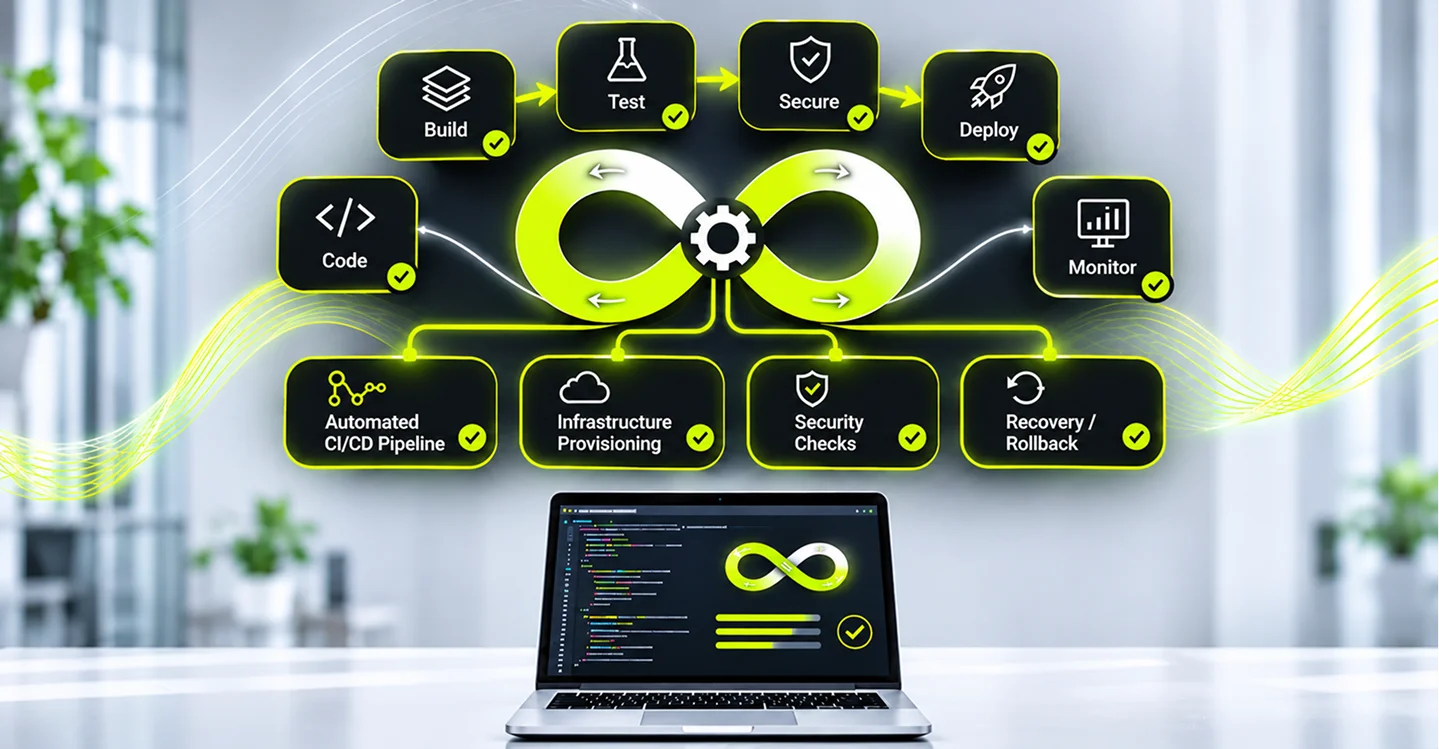







Modern delivery involves constant builds, tests, infrastructure changes, security checks, and releases. When these rely on manual effort, teams face slower releases, inconsistent environments, and avoidable deployment risk. Our DevOps automation company links these activities into automated workflows that improve delivery consistency and operational control.
From CI/CD pipelines and Infrastructure as Code to automated testing, cloud provisioning, security validation, and monitoring, businesses build a stronger delivery foundation. Our DevOps experts' teams spend more time improving applications and less time on repetitive operational tasks.
Our DevOps automation services connect development, infrastructure, testing, security, deployment, and monitoring into repeatable workflows. We automate manual delivery tasks, standardize engineering processes, and help teams release software with greater control and consistency.
We automate the path from code commit to release, so your teams can build, test, validate, and deploy software with fewer manual handoffs. Our CI/CD pipeline services bring consistency to releases while giving teams better visibility into build quality and deployment readiness.

We make application deployments repeatable and controlled, reducing release errors while helping teams deliver updates with greater confidence. Our workflows automate configurations, deployment strategies, and rollback processes across environments.

Our experts automate infrastructure provisioning and scaling to reduce repetitive work, configuration errors, and delays across your environment. Our approach helps teams manage cloud and on-premises resources as application requirements change.

We turn infrastructure into version-controlled code, making environments easier to create, review, update, and reproduce. Our IaC approach reduces manual provisioning while giving your teams a clearer way to manage infrastructure changes.
Our experts use Git as the central source of truth for managing application and infrastructure changes, keeping deployments consistent and traceable. Our GitOps workflows automate configuration synchronisation, reconciliation, approvals, and environment updates.

We automate the coordination behind complex releases, connecting deployment, testing, approvals, monitoring, and rollback into one controlled workflow. This helps your teams reduce manual coordination and make releases more predictable across applications and environments.
Connect CI/CD, deployment, IaC, GitOps, and release automation to create a controlled path from code to commit to production.
DevOps automation is not only about making deployments faster. Its broader value comes from creating consistency across software delivery and reducing the amount of repetitive operational work handled manually.
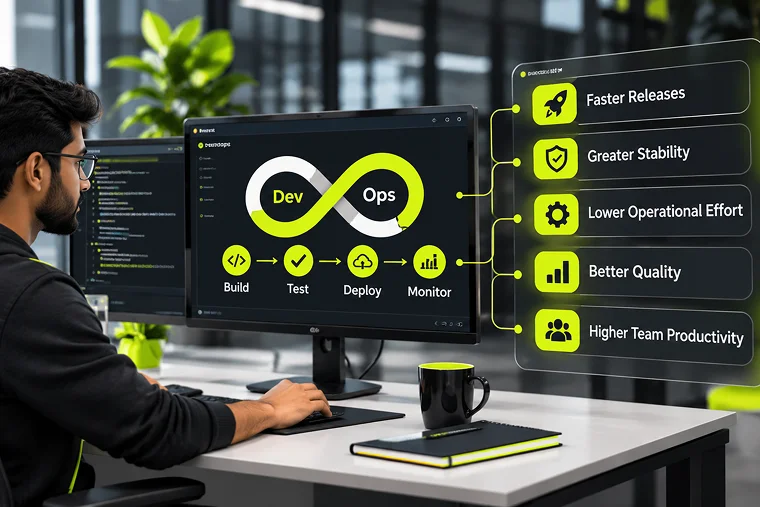
Automated build, testing, deployment, and infrastructure workflows reduce handoffs between development and operations teams.
Infrastructure and configuration automation keeps development, testing, staging, and production aligned to the same standards.
Automated testing and quality checks, supported by our cloud and DevOps consulting services, identify problems close to the point where code changes are introduced.
Repeatable deployment workflows reduce dependence on manual release steps and individual knowledge.
Automation makes it easier to provision and manage resources as application requirements change.
Automated monitoring, logging, metrics, and alerts give teams a clear view of application and infrastructure health.
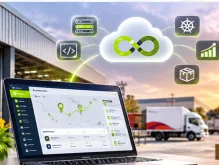 Cloud-Native Transformation with DevOps AutomationReliance Jio needed to modernize its infrastructure and move from on-premises systems and monolithic architecture toward cloud-native microservices.
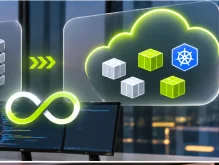 Cloud & DevOps Transformation for Scalable LogisticsEcom Express needed to handle growing shipment volumes, real-time tracking requirements, and traffic spikes without allowing infrastructure bottlenecks to slow operations.
 Integrated Managed DevOps & Cloud TransformationA leading two-wheeler manufacturer was dealing with rising cloud costs, performance bottlenecks, limited automation, and gaps in monitoring.
We choose tools to match your existing environment, not the other way round. The right DevOps automation stack depends on your development environment, cloud infrastructure, application architecture, security requirements, and workflows. At DevOps Experts India, we select and integrate the tools that fit your technology ecosystem and delivery goals.
 Jenkins
 GitHub Actions
 GitLab CI/CD
 Azure DevOps
 CircleCI
 Bitbucket Pipelines
 Terraform
 AWS CloudFormation
 Azure Bicep
 Ansible
 Pulumi
 Docker
 Kubernetes
 Helm
 OpenShiftAWSMicrosoft Azure
 Google CloudAnsible
 Puppet
 Chef
 Prometheus
 Grafana
 Datadog
 New Relic
 Elastic Stack
 Git
 GitHubGitLabBitbucketAzure Repos
 SonarQube
 Snyk
 Trivy
 OWASP tools
DevOps automation services should fit into the existing technology environment instead of forcing businesses to replace every tool or workflow. Our implementation process focuses on understanding current delivery practices, identifying repetitive activities, and introducing automation in controlled stages.
Review the existing development workflow, infrastructure, deployment process, testing practices, cloud environment, source-control systems, security requirements, and operational dependencies.
Map repetitive activities, manual handoffs, environment inconsistencies, deployment bottlenecks, testing gaps, and operational tasks that can benefit from automation.
Our site reliability engineering services Create the target architecture for CI/CD, infrastructure automation, testing, security, deployment, monitoring, secrets management, and recovery.
Develop pipelines, infrastructure definitions, automation scripts, integrations, quality gates, monitoring workflows, and deployment processes.
Our DevOps automation services test automation workflows in development and staging environments before introducing them into production.
Move validated automation into production while documenting workflows and helping engineering and operations teams adopt the new processes.
From automating CI/CD pipelines to implementing GitOps release workflows, consistency, and operational control.
DevOps automation needs to account for the architecture, release model, infrastructure, compliance requirements, and operational complexity of each environment.
Automate complex application delivery workflows across multiple teams, environments, dependencies, and release stages.
Automate cloud infrastructure, containers, deployments, scaling, monitoring, and security for applications built around modern cloud architectures.

Create repeatable release and infrastructure workflows that support frequent product updates, multiple environments, and growing customer demand.

Automate independent service builds, testing, containerisation, deployment, service configuration, and monitoring across distributed architectures.
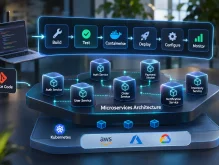
Introduce automation into existing applications gradually without requiring an immediate replacement of the entire technology environment.

Support product teams with automated build, test, release, monitoring, and rollback workflows that improve development consistency.

Automate infrastructure, data pipelines, model environments, testing, deployment, monitoring, and supporting cloud resources where required.

Build controlled automation workflows with appropriate security checks, approval gates, audit trails, access controls, and compliance requirements.
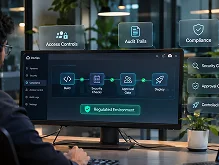
Enterprise automation requires more than connecting a few CI/CD tools. It needs an architecture that balances automation, control, security, scalability, and the practical needs of engineering teams.
Automation starts with business and engineering bottlenecks, focusing investment on measurable improvements rather than adopting tools without clear operational value.
Our DevOps experts design connected automation across pipelines, infrastructure, environments, security controls, monitoring, and deployment workflows for consistency.
Automation is introduced in manageable phases, allowing teams to validate improvements, address issues, and expand adoption across environments confidently.
Security and compliance checks become integrated into development and deployment workflows, reducing manual validation while identifying risks earlier during delivery.
Our DevOps automation services use version-controlled infrastructure definitions to create, configure, update, and maintain consistent environments through controlled processes.
Automation is continuously monitored to identify pipeline bottlenecks, failed processes, unnecessary manual steps, performance gaps, and emerging opportunities for improvement.
| Process Area | Traditional Approach | Automated DevOps |
|---|---|---|
| Application Build | Manual or semi-manual build activities | Automated build pipelines |
| Testing | Testing performed at selected stages | Automated tests integrated into CI/CD |
| Deployment | Manual deployment steps | Repeatable deployment workflows |
| Infrastructure | Manually configured environments | Infrastructure as Code |
| Configuration | Environment-specific manual changes | Version-controlled configuration |
| Security | Security checks often handled separately | Security checks integrated into pipelines |
| Monitoring | Manual monitoring and investigation | Automated monitoring and alerts |
| Release Frequency | Limited by manual processes | Supports more frequent releases |
| Operational Work | High volume of repetitive tasks | More automated operational workflows |
We at DevOps Experts India, present the DevOps automation services that offers the operational & development efficiency at scale.
Hire DevOps engineers to design automation around actual development, infrastructure, security, and operational requirements instead of adopting tools without clear business purpose.
From source control and CI/CD to infrastructure, security, deployment, monitoring, and recovery, our automation approach can span your complete software delivery lifecycle.
Our automation architectures support AWS, Azure, Google Cloud, containers, Kubernetes, and hybrid environments while aligning workflows with your existing infrastructure and technology requirements.
New automation workflows are tested and validated before production adoption, helping reduce operational disruption while giving engineering teams confidence in automated processes.
Automation is designed to accommodate additional applications, environments, teams, workloads, and infrastructure as your technology ecosystem expands and operational requirements become more complex.
Post-implementation support can cover pipeline optimisation, infrastructure updates, monitoring, troubleshooting, security improvements, workflow maintenance, and new automation requirements as your environment changes.
Build an automation framework that gives engineering teams greater control over how software is developed, tested, deployed, monitored, and maintained.
Consult Our DevOps Automation Services