01
Enterprise Applications
Define measurable reliability targets, ownership models, incident processes, and service dependencies across complex enterprise applications supporting multiple business teams.

Our DevOps SRE services help engineering teams manage production reliability without compromising release speed. From setting measurable service objectives to automating incident recovery, we strengthen the systems and processes that keep applications available, responsive, and ready to handle changing workloads.







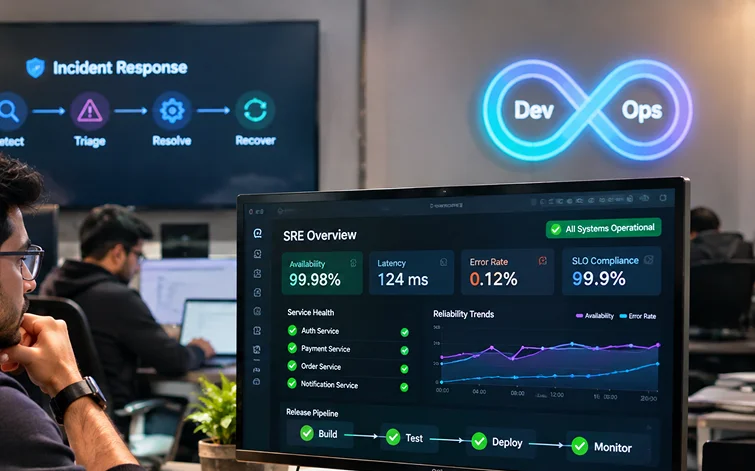
A reliable application is not simply one that stays online. It needs to deliver consistent performance, respond predictably under load, recover quickly from failures, and provide users with a stable experience. Without measurable reliability targets, teams often discover problems only after they affect customers.
Our DevOps Site Reliability Engineering services bring reliability engineering into the software delivery lifecycle. Our DevOps Experts India team establishes SLIs and SLOs, implements service-level monitoring, manages error budgets, improves alert quality, automates repetitive operational tasks, and strengthens incident response processes. By connecting reliability data with release decisions, we help engineering teams reduce operational toil while continuously improving application availability, performance, and resilience.
Our DevOps site reliability engineering solutions connect reliability targets, monitoring, incident response, automation, and capacity planning into one operating model. We help teams decide how reliable a service needs to be, measure it, and engineer the systems and processes to meet that target.

Turn reliability into measurable engineering goals. We define service indicators, reliability targets, and error budgets that help teams make informed decisions about releases, risk, and operational priorities.

Create unified visibility across applications, infrastructure, and dependencies. We connect metrics, logs, traces, and service health signals to help teams identify performance issues and understand their impact.

Build a structured approach to incidents with clear ownership, escalation paths, and response procedures. We help teams reduce recovery time while capturing lessons that prevent recurring failures.

Our DevOps automation services reduce repetitive operational work through automation that improves consistency and gives engineers more time for reliability improvements, system optimisation, and higher-value engineering activities.

Prepare systems for changing workloads through performance analysis, capacity modelling, and scalability testing. We help teams identify bottlenecks early and maintain predictable application performance as demand grows.

Validate how systems behave when components fail, dependencies become unavailable, or workloads increase unexpectedly. Controlled failure testing helps teams identify weaknesses before they affect production users.
Define reliability targets, reduce incidents, and release with confidence using our DevOps site reliability engineering solutions.
SRE is not only about fewer outages. Its broader value comes from replacing guesswork with data and giving teams a shared language for reliability, risk, and speed.

Better monitoring, clear response processes, and learning from past failures help teams detect issues earlier, reduce downtime, and recover faster.
SLOs connect technical performance with customer experience, helping teams prioritize reliability investments according to business impact rather than assumptions or technical preferences.
Error budgets and progressive delivery help teams release confidently when services remain healthy while controlling deployment risks when reliability begins declining.
Automation reduces repetitive manual tasks across monitoring, remediation, maintenance, and operations, allowing engineers to focus on higher-value reliability improvements and innovation.
Tuned alerts, documented runbooks, and clear ownership reduce unnecessary escalations, engineer fatigue, and dependency on individual team members for critical operational knowledge.
Capacity planning and performance engineering help systems handle changing workloads while reducing unexpected outages and unnecessary operational costs. Our DevOps experts can add roadmaps for wider platform improvement.
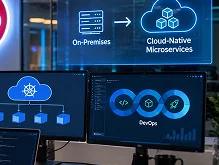 Cloud-Native Transformation with DevOps AutomationReliance Jio needed to modernize its infrastructure and move from on-premises systems and monolithic architecture toward cloud-native microservices.
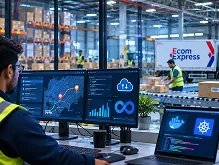 Cloud & DevOps Transformation for Scalable LogisticsEcom Express needed to handle growing shipment volumes, real-time tracking requirements, and traffic spikes without allowing infrastructure bottlenecks to slow operations.
 Integrated Managed DevOps & Cloud TransformationA leading two-wheeler manufacturer was dealing with rising cloud costs, performance bottlenecks, limited automation, and gaps in monitoring.
Hire DevOps engineers to choose an SRE technology stack that fits your architecture, cloud platform, monitoring tools, and operational workflows.
 Prometheus
 Grafana
 Datadog
 New Relic
 Elastic Stack
 OpenTelemetry
 PagerDuty
 Opsgenie
 Jira Service Management
 ServiceNow
 Slack and Microsoft Teams workflows
 Docker
 Kubernetes
 Helm
 OpenShift
 Terraform
 Ansible
 AWS CloudFormation
 Azure Bicep
 Pulumi
 Jenkins
 GitHub Actions
 GitLab CI/CD
 Argo CD / Argo Rollouts
 Flux
 Chaos Mesh
 LitmusChaos
 Gremlin
 k6
 Apache JMeter
 Locust
 Gatling
DevOps site reliability engineering services should fit your existing teams and tools instead of requiring a full reset. We introduce SRE practices in stages, starting with your most critical services.
Review architecture, monitoring, incidents, on-call practices, deployment workflows, dependencies, and critical services to understand current reliability gaps and operational risks.
Align engineering and business teams on measurable reliability targets, service indicators, error budgets, and release policies based on business priorities.
Implement metrics, logs, traces, dashboards, and actionable alerts aligned with SLOs to improve service visibility and reduce unnecessary notifications.
Define incident roles, escalation paths, runbooks, communication workflows, and post-incident reviews to create consistent and effective operational response processes.
Identify repetitive operational tasks and replace them with automation, self-healing workflows, Infrastructure as Code, and standardized operational processes.
Validate resilience through load testing and controlled failure experiments, then expand SRE practices across additional services as operational maturity improves.
From SLO definition to incident response and automation, get a clear reliability roadmap for your critical services.
SRE practices need to account for the architecture, release model, compliance requirements, and operational complexity of each environment.
Define measurable reliability targets, ownership models, incident processes, and service dependencies across complex enterprise applications supporting multiple business teams.
Build observability, automated scaling, fault tolerance, and resilience into containerised applications and cloud-native architectures from development onwards.

Our DevSecOps consulting services support uptime commitments, customer experience, secure operations, and frequent product releases across SaaS environments.

Manage service-level objectives, distributed tracing, dependency health, and failure handling across interconnected microservices and distributed application architectures.
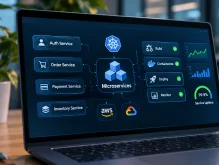
Improve stability, monitoring, and operational visibility across legacy systems while supporting gradual modernisation without disrupting critical business operations.

Keep customer-facing journeys responsive, reliable, and available during peak traffic, seasonal demand, campaigns, transactions, and unexpected workload increases.

Improve reliability across data pipelines, model-serving environments, processing workloads, APIs, and infrastructure supporting business-critical artificial intelligence platforms.

Support availability, auditability, access controls, incident documentation, compliance requirements, and recovery processes across highly regulated technology environments.

Enterprise reliability needs more than dashboards and an on-call rota. It needs shared targets, clear ownership, and a culture that learns from failure.
Set reliability targets around critical services and user journeys that directly influence revenue, customer experience, operational continuity, and business trust.
Use SLOs, error budgets, performance metrics, and incident data to determine where teams should improve stability or accelerate delivery.
Use post-incident reviews to identify system and process weaknesses, helping teams address root causes without assigning individual blame.
Replace recurring manual interventions with automation, self-healing workflows, and standardized processes instead of depending on individual engineers during incidents.
Start SRE practices with critical services, measure improvements, refine processes, and gradually expand adoption as engineering teams gain confidence.
Regularly review reliability metrics, alerts, runbooks, SLOs, and automation to identify improvement opportunities and strengthen operational performance continuously.
| Process Area | Traditional Operations | SRE-Led Operations |
|---|---|---|
| Reliability Goals | Informal or uptime-based | Defined SLIs and SLOs |
| Release Decisions | Based on schedule or opinion | Guided by error budgets |
| Monitoring | Infrastructure-level alerts | Service and user-impact monitoring |
| Alerts | High noise, frequent false alarms | Tuned, actionable alerting |
| Incident Response | Ad hoc, depends on individuals | Structured roles and runbooks |
| Post-Incident Learning | Limited or blame-focused | Blameless reviews with tracked actions |
| Operational Work | High volume of manual toil | Automation and self-healing |
| Team Focus | Constant firefighting | Planned reliability improvements |
We at DevOps Experts India help engineering teams make reliability measurable, predictable, and sustainable.
We build reliability targets and priorities around your users, critical business processes, customer expectations, and operational goals rather than applying generic SRE frameworks.
Our expertise spans CI/CD, infrastructure, observability, incident response, performance, resilience, recovery, and continuous improvement across the complete software delivery lifecycle.
Our team works across AWS, Azure, Google Cloud, Kubernetes, and hybrid environments, adapting SRE practices to your existing architecture and platform requirements.
We begin with critical services, demonstrate measurable value early, and gradually expand our SRE services without disrupting ongoing development, releases, or operations.
Start with an SRE assessment or continue with ongoing support. Our DevOps managed services can manage operations while experts work alongside your team.
Runbooks, documentation, training, and operational guidance help your engineering teams understand, maintain, and continuously improve the reliability practices introduced across your technology environment.
Build an SRE practice that reduces incidents, protects customer experience, and gives engineering teams more time to build.
Consult Our SRE ExpertsThe automation-first approach significantly improved how our development and operations teams managed releases. From CI/CD to infrastructure provisioning, the new processes made deployments more consistent and easier to manage.
The DevOps team brought structure and automation to our deployment process. The improved CI/CD workflows and cloud-native approach helped us release faster while maintaining the reliability our platform demands.
Our infrastructure needed to handle changing traffic volumes without compromising performance. The cloud and DevOps improvements gave us better scalability, monitoring, and deployment consistency across critical logistics operations.