01
Enterprise Applications
Modernize large enterprise systems to reduce maintenance costs, improve integrations, and create faster release cycles across multiple teams and environments.

Your legacy applications create technical debt, slow-release cycles, and rising maintenance costs. As a cloud application modernization company, we re-engineer how your applications are built, deployed, and scaled. Our cloud application modernization services remove the architectural constraints that limit how fast your engineering teams can move.
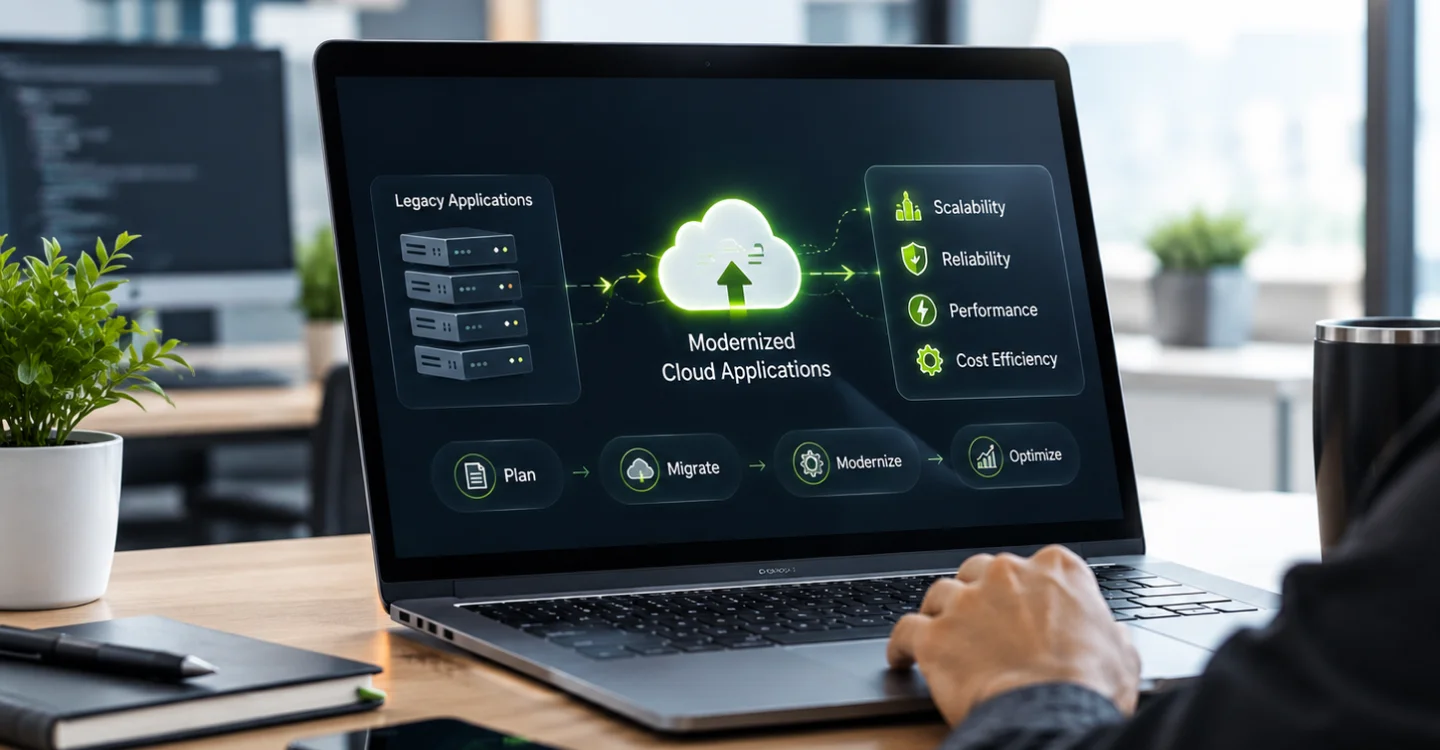







Slow releases, rising maintenance costs, and fragile deployments are symptoms of architectures built for a different era. Patching legacy systems only delays the problems your engineering teams face every sprint.
Our cloud application modernization solutions address root causes. We assess your application portfolio, identify what is slowing delivery and raising costs, and redesign applications to work with modern cloud infrastructure and DevOps software delivery solutions. The result is software that deploys faster, scales more efficiently, and costs less to maintain.

Legacy applications often struggle to integrate with CI/CD pipelines, security automation, and cloud services. Modernized applications eliminate these barriers, enabling seamless integration with the DevOps software delivery solutions your teams rely on.
Outdated systems require expensive proprietary infrastructure and heavy manual maintenance. Cloud-native architecture reduces licensing costs and operational overhead.
Legacy applications resist integration with CI/CD pipelines, security automation, and cloud services. Modernized applications connect with the DevOps software delivery solutions your teams depend on.
Monolithic applications scale as a unit even when one component needs more capacity. Cloud-native architecture scales individual services on demand and reduces wasted infrastructure spending.
Legacy systems accumulate unpatched vulnerabilities and block automated security controls. Modern cloud applications support container scanning, secrets management, and policy enforcement in every pipeline.
Developers maintaining legacy systems spend more time on workarounds than on features. Modernized architectures reduce cognitive load and create faster development feedback loops.
We combine application assessment, architecture redesign, cloud migration, containerization, and DevOps integration to deliver applications that support reliable, scalable delivery.

We analyze your existing applications for architecture constraints, technical debt, integration gaps, and cloud readiness. The assessment produces a prioritized modernization roadmap built around your delivery goals.

We migrate applications to cloud infrastructure with minimal code changes where it delivers immediate cost and performance value. We replatform onto managed cloud services to reduce maintenance overhead.

We redesign tightly coupled components to reduce dependencies and improve deployability. Teams gain the ability to release and scale individual services without coordinating large application deployments.

We containerize applications using Docker and orchestrate them with Kubernetes. Your teams deploy consistently across development, staging, and production without environment-specific configuration failures.

We break monolithic applications into independently deployable services. Individual teams own, release, and scale their components without depending on large, coordinated deployment cycles.

We re-engineer legacy integrations and expose services through modern APIs. Your applications connect with internal systems, third-party platforms, and current cloud services without brittle point-to-point connections.

We connect modernized applications with CI/CD pipelines, automated testing, infrastructure as code, and deployment automation. Delivery improvement is built into each modernization stage, not added at the end.
Cloud application modernization company engagements succeed when the outcome is measurable, not just technical. Real value is a faster, more stable path between development and production.
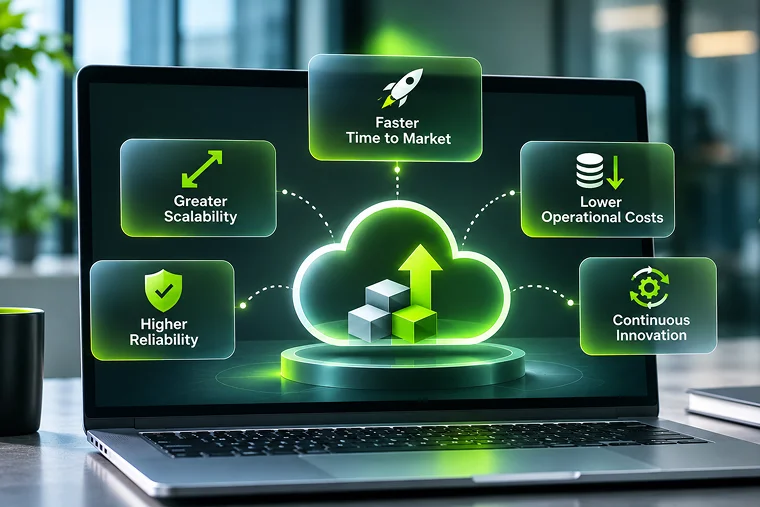
Modernized applications support releases in 24 to 40 hours depending on the strength of the expertise. Teams spend less time blocked by environment failures, manual approvals, and deployment of coordination.
Smaller, more frequent releases are easier to test, monitor, and reverse. Automated health checks and rollback mechanisms reduce the impact of production incidents.
Legacy applications struggle to integrate with CI/CD pipelines, security automation, and cloud services. Modernized applications integrate seamlessly with the DevOps software delivery solutions your teams rely on.
Modern applications support automated scanning, image signing, and compliance enforcement. Security is integrated into delivery pipelines rather than applied manually after release.
Teams working on modernized systems ship faster and fix defects closer to their origin. Less engineering time goes to maintenance that delivers no direct business value.
We track deployment frequency, lead time, change failure rate, and mean time to recover. Progress is quantifiable from the first stage of modernization.
Every engagement starts with a specific delivery problem, a cost constraint, or a security gap that limits what engineering teams can do. As one of the largest cloud application modernization companies, we turned those constraints into measurable outcomes across real client environments.
 Securing a Connected Car Platform Before Attackers Found the GapsAs a leading Indian automotive manufacturer scaled its IoT-based connected car mobile application, security gaps across user data handling, app communication, and vehicle service integrations became a critical risk. The team needed to identify and close vulnerabilities before releasing new connected car features to a wider audience.
 Building a Security-First DevOps Foundation for a High-Growth FinTech PlatformA fast-growing FinTech startup expanding digital wallet, instant payment, and investment services needed infrastructure that could scale quickly without compromising security or availability. Manual deployments, limited system visibility, and reactive security practices were creating operational risk as user volumes and transaction loads increased.
 A Scalable DevOps Foundation That Helped a Cloud Startup Compete at SpeedAn early-stage cloud solutions provider needed to launch and iterate on new services at a pace competitive with established cloud platforms. Traditional development and infrastructure processes were slowing deployments, limiting scalability, and creating manual operational overhead that the team could not sustain as customer demand grew.
The right toolchain depends on your existing architecture, cloud platform, team structure, and compliance requirements. We work with the tools your teams already use and recommend changes only where they improve modernization outcomes.
 AWS (EKS, ECS, Lambda, RDS, Aurora)
 Azure (AKS, Azure Functions, App Service, Azure SQL)
 Google Cloud (GKE, Cloud Run, Cloud SQL, Cloud Build)
 Docker
 Kubernetes
 Helm
 OpenShift
 TerraformAWS CloudFormationAzure Bicep
 Pulumi
 Ansible
 GitHub Actions
 GitLab CI/CD
 Jenkins
 Azure DevOps
 CircleCIAWS API GatewayAzure API Management
 Snyk
 TrivyAWS Security HubAzure Defender for Cloud
 Prometheus
 Grafana
 Datadog
 New RelicAWS CloudWatchAzure Monitor
Our cloud application modernization services follow a structured process that keeps live systems stable while modernization progresses in controlled stages. Each step delivers measurable improvement before the next begins.
We evaluate your applications for architecture patterns, technical debt, cloud readiness, integration dependencies, and operational costs. The assessment identifies which applications to rehost, replatform, refactor, or rebuild.
We rank modernization candidates by business impact, delivery risk, cost reduction potential, and technical feasibility. Quick wins deliver early value while longer-term rearchitecting work runs in parallel.
We design service boundaries, API contracts, data migration approach, and cloud infrastructure before any migration begins. Architecture decisions are validated against delivery, performance, and compliance requirements.
We modernize in controlled stages rather than large-scale cutovers. Each stage is validated against functionality, performance, and security criteria before the next one begins.
We connect modernized services with CI/CD pipelines, automated testing, infrastructure as code, and deployment automation. Delivery improvements start in the first stage, not after the full migration is complete.
We validate each modernized service against defined reliability, performance, and security targets. Observability tools monitor live behavior and surface issues before they reach end users.
Modernize large enterprise systems to reduce maintenance costs, improve integrations, and create faster release cycles across multiple teams and environments.
Re-engineer SaaS products for cloud-native scalability so teams can release faster, scale individual components, and reduce per-customer infrastructure costs.

Modernize transaction systems and customer-facing platforms with security controls and compliance automation built directly into the delivery process.

Update product, order, and customer systems to handle traffic peaks and connect reliably with warehouse, logistics, and payment integrations.

Modernize clinical and patient-management software while maintaining compliance with data security and regulatory requirements across cloud environments.

Rearchitect internal tools and workflow platforms to reduce maintenance effort and connect cleanly with the systems your teams use daily.

Modernize data pipelines and model-serving infrastructure so they deploy frequently, scale independently, and integrate with live production systems.