In today’s fast-paced digital environment, security cannot be an afterthought. Entrepreneurs seeking to balance speed and security in their development processes are turning to DevSecOps—a methodology that integrates security practices into every phase of the DevOps pipeline.
This DevSecOps best practices guide provides guidance and solutions so that you get the best of both worlds—robust security as well as competitive velocity.
The Role of DevSecOps in Business Success
DevSecOps cannot be viewed as another trend anymore, as it is the way that can make a business more competitive in the digital environment. By embedding security within the development lifecycle, businesses can:
Minimize vulnerabilities: Learn how to prevent them before they occur.
Enhance customer trust: They build confidence in the users or rather offer security to the applications.
Ensure compliance: Comply with rules like the GDPR and ISO standards to minimize the chance of being penalized with very big amounts of money.
For instance, using DevSecOps, engineering practitioners have praised it with reductions in product release time and incidences of security breaches, hence enormous savings on costs.
In this article, we will be discussing the best practices any organization can consider implementing when adopting DevSecOps as its implementation strategy.
Top 10 DevSecOps Best Practices
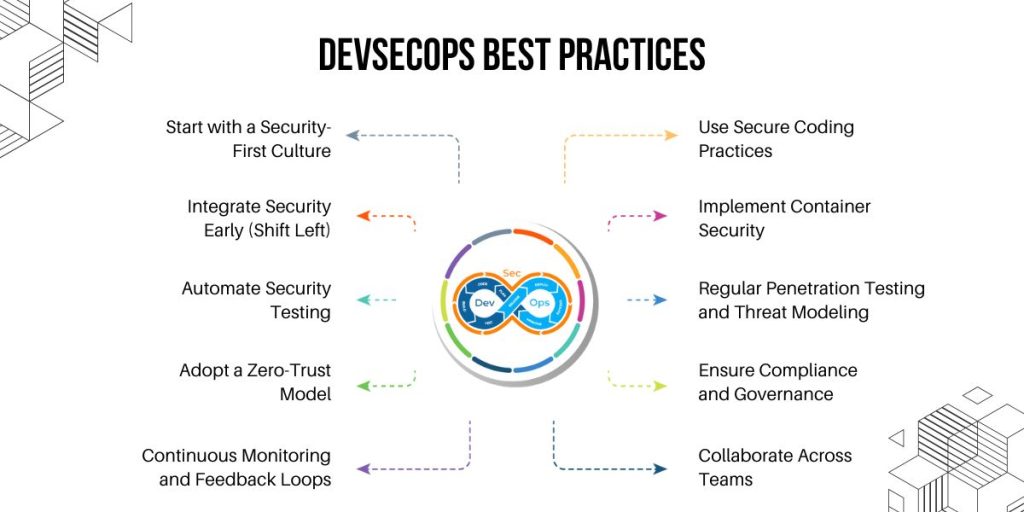
1. Start with a Security-First Culture
Enforcing a security awareness culture means that every single member of the team has security at the back of their mind.
Entrepreneurs should:
Security knowledge should be periodically refreshed in the developers and operations teams as far as threats and protective measures are concerned.
Encourage a security culture where the responsibility is cast as a corporate or organizational one where everyone in an organization has the responsibility of a security officer. Security-oriented principles are the way to go when making DevSecOps a part of your business process since security should be everyone’s top priority.
2. Integrate Security Early (Shift Left)
This is all about moving security issues to the left, which extends it to be a part of the development life cycle, thus avoiding the disasters that may be so costly to correct at development stages farther down. Effective strategies include:
Introducing threat modeling at the time of design to facilitate the identification of possible threats way before they surface.
Providing architects and developers with the tools that they need to write more secure code from the ground up.
Related Blog: DevOps vs. DevSecOps: The Ultimate 2025 Guide for Modern Development Practices
3. Automate Security Testing
Through automation, those gaps are identified and rectified at a faster pace, freeing up a development team from having to be continually concerned with security lapses. Entrepreneurs can:
Integrate the security checks into their CI/CD systems to begin recognizing problems as soon as code is committed.
All the vulnerability scanning should be done in the right way without compromising on the quality of scans, so the recommended tools are OWASP ZAP or Snyk for effective scans.
4. Adopt a Zero-Trust Model
The zero-trust model is a particular type of security model that expects that no user or device on a network can be trusted. Key elements include:
Applying MFA to strengthen the barriers while logging into any systems or applications.
Applying RBAC to minimize privileges for users and provide protection from insiders.
Prolonged authentication of the user and continually confirming the devices to meet compliance standards.
A zero-trust model means that a minimal attack surface is provided, and there are further layers of protection even if the first one gets breached.
5. Continuous Monitoring and Feedback Loops
This approach provides a constant view of all possible risks within an organization and lets different teams address the threats at once. Steps include:
Using Splunk, Datadog, or ELK Stack and other related tools with the ability to parse through the application and infrastructure logs to detect unusual patterns.
Implementing preventive measures like the establishment of alarm systems to inform teams of signs of compromise.
Creating feedback loops for cross-team sharing of best practices as well as identifying experiences that can be shared in other teams to enhance positive changes.
There is early detection of security problems and an ability to deal with minor anomalies before they graduate to major problems.
6. Use Secure Coding Practices
One such practice is gaining increased popularity known as secure coding, whose purpose is to lower the injection of vulnerabilities during the development phase.
Entrepreneurs should ensure their teams:
Follow OWASP’s Secure Coding Guidelines, which provide best practices for mitigating common vulnerabilities like SQL injection and cross-site scripting.
Peer code reviews, which should be conducted from time to time, ensure that at least one developer has seen the code and alert the team of any hidden security problems while providing a forum for knowledge sharing.
It is recommended that developers be trained and supported so they can learn new methods and standards for secure development and the latest threats.
DevSecOps needs strong secure coding as a foundation of the pipeline that must be in place as the primary number one priority in software development.
7. Implement Container Security
Flexibility and scalability are provided by the containers but come with new security risks. To secure containerized environments:
To ensure that there aren’t many vulnerabilities within the container images before they are deployed, one can use image scanning tools.
The following are the measures to be installed at the runtime to inspect the activities of the containers and identify any peculiar activities.
Periodically, you need to update as well as patch the container images to mitigate the known vulnerabilities.
8. Regular Penetration Testing and Threat Modeling
Testing enables the identification of vulnerabilities and assists the business to be one step ahead of the hacker.
Key practices include:
When campaigns aggressively target an organization’s applications and infrastructure, regular penetration tests should be performed to replicate actual attacks and check for weaknesses.
With the help of such threat modeling tools as Threat Dragon, which allows identifying main threats and learning more about them to develop desired measures.
We outline discoveries that must be recorded and used in subsequent phases of development to enhance security.
All these preventive measures help business organizations to remain protected when facing new challenges in terms of security threats.
9. Ensure Compliance and Governance
Adherence to industry standards is highly important since its failure threatens customer loyalty and invites legal action. Steps include:
For instance, compliance tools undertake frequent assessments of organizations to confirm that they follow standards like GDPR HIPAA, or PCI DSS.
Another factor common among the best compliance programs is the ongoing review and assignment of compliance methods for changes in regulation and standards.
10. Collaborate Across Teams
Security integration is therefore best brewed in multi-disciplinary participation when being implemented in the various workflows. Techniques include:
Make sure to hold cross-functional goals and training sessions, especially for goals set in the development, security, and operations departments.
Sharing openness via boards to track security duties and advancement utilizing Jira or Trello.
It removes barriers between teams and makes everyone focus on the result of the work, which means fast and safe delivery of software products.
Advantages of Implementing the Best Practices

Adopting a DevSecOps best practices guide leads to:
Enhanced productivity: Teams already waste less time on security issues while they invest more time in novelties.
Cost savings: Security management prevents costly repairs after the production and production halt, therefore cutting the cost of doing business.
Improved reputation: Businesses that prioritize security build trust with customers, enhancing their brand image.
Challenges Entrepreneurs May Face
Adopting and integrating DevSecOps practices may not be easy. Common hurdles include:
Resistance to change: People working in teams may refuse to change the ways they work.
Balancing speed and security: The organizational changes, when implemented, may take time to offer quick results and might even delay the delivery of results.
Budget constraints: Good equipment and skills-enhancing programs are expensive to acquire for small business organizations.
Some Probable Solutions to These Challenges
Start Small: Gradually introduce practices to minimize resistance from various stakeholders.
Leverage Open-Source Tools: OWASP tools are some of the most affordable out there, making them perfect for starting a small business.
Partner with Experts: An effective way of putting structure to the changes and achieving the results faster could be to hire a DevSecOps engineering team.
Hire Experienced DevOps Engineers to Optimize Your Workflow!
Concluding Thoughts
DevSecOps emphasizes making security an organic part of the entire system rather than merely embedding it. This DevSecOps best practices checklist can help any entrepreneur to have an effective, secure, and compliant SDLC pipeline. It is high time to adopt DevSecOps in the organizational environment to be successful in the present competitive world.
FAQs
What is the primary goal of DevSecOps?
DevSecOps aims to embed security into development and operations as a core element, not an add-on.
How does automation help in DevSecOps?
Automation simplifies security processes, speeds them up, and enables clients to address vulnerabilities more quickly. It minimizes the possibility of errors and maintains the standard of security inspections in development.
What tools are essential for DevSecOps implementation?
Essential tools include:
Browser and proxy tools for both methods include vulnerability scanners for static (e.g., SonarQube) and dynamic (e.g., OWASP ZAP) application security testing.
CI/CD pipeline integrating tools (Jenkins, GitLab, and others).
Examples of real-time monitoring tools are Splunk, Datadog, and so on.
Can small businesses implement DevSecOps effectively?
Yes, small businesses can begin using only open-source tools and only gradually incorporate complex approaches. It also aids in transitioning to DevSecOps, which is more affordable and easier with a DevSecOps engineering service provider.